


Invest in the Medusascope
Work with us to create the new generation of medical tooling
Up to 2017, Surgical Synergy Limited (SSL) has raised £650k through 3 private equity tranches and 2 Government grants. This allowed us to design, develop and test the original α-prototype. The findings and lessons learned have underpinned the evolution of the current β-prototype, which now meets the functional requirements originally defined and will shortly enter further user testing.
This EIS round, with HMRC advance approval confirmed, seeks a further £1.15m equity funding. £200k has already been committed by existing investors, leaving £950k to close the round. A £350 SMART Grant application has been positively received, though we need to demonstrate the success of this funding round before it moves onwards to award. This round is required to provide the resource for refinement, manufacturing design and completion of accreditation ready for transition and entry into market.
There is a potential “Series “A” round to follow, once CE certification has been achieved, for £4m as a final equity tranche. This round is required to fund the FDA accreditation and development of the additional products planned for the SSL product pipeline.
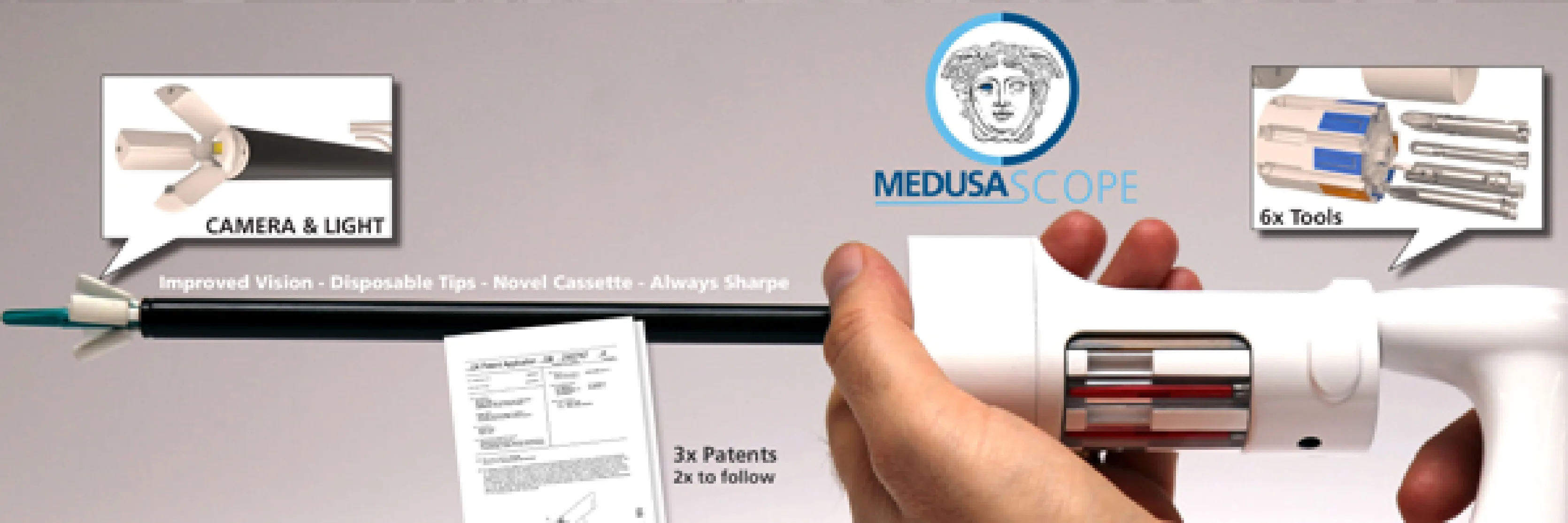

Funding of £498k was secured to develop a basic working prototype and surgeon testing is now underway to identify design and performance improvements.
The Endoscopic market is estimated to be $32.5bn (2015), and is forecast to grow to $45.2bn by 2020. $4.5bn directly accessible to this product and adoption of minimally invasive procedures is forecast to accelerate.
The current funding round is to support the refinement of the prototype to ensure it really meets surgeon expectation and needs – but then to accreditation and commercialisation.
Progression from now through to manufacture- readiness is forecast to take 18 months.. Future developments now at design stage include a flexible articulating version, unlike anything the company believes is currently on the market, and a small bore version with the same capabilities, but capable of working in constrained spaces.
Market expectations for products with both medical and economic benefits are strong.
 “
“If you’d like to learn more about the Medusascope, please leave your details below and we will email you with access to our investor portal to gain access to information so you can make an informed decision about The Medusascope.

The Medusascope was conceived and designed by Dr Martin Knight, a pioneering Endoscopic spine surgeon who has already developed an endoscope for the niche spine market, which listed on AIM.
The existing investors have contributed a further £350,000 together with a Government grant of £350,000. These funds are being used already to continue the advancement of this project.
